With all the snow gone, it was time for a spring inspection of the trail around the East Branch Nature Preserve this week and there were a few surprises. A stand of birch (pictured above) in the switch-back turn in the northernmost part of the trail by the outdoor classroom were almost completely prostrate, as if they were frozen in time while taking their last bow to the audience. It’s likely they were dying and buckled under the weight of snow. There is another stand of birch nearby unscathed.
The lack of foliage and snow revealed more vines: black, gnarled, and striated, they wound around trees like the crab apples and ironwoods. This is not a common sight in the Catskills, especially seeing specimens that are so ancient looking – mummified, like they belong in the last Roman Empire. Who planted them and when?
There were the furry, sage green, first year basal rosettes of mullein scattered on the trail, and some new poop: we still have our prolific hunter in the south portion of the trail that for some reason makes it really obvious that they’ve been there, always fertilizing the trail itself. It could be an owl, coyote, or fox, but we won’t find out until we put up a trail cam.
The beavers have added a satellite work station to their staging area. There is a downed tree much further north towards the outdoor classroom. This tree is all alone in a little thicket, and it will either be dragged south to be part of the dam in progress, or used for a new dam, or maybe it’s a spare tree that the beavers have hidden in the undergrowth as an emergency. Nevertheless, those beavers have been hard at work over the winter, just like the rest of us.
There is a carpet of what looks like cow parsley by the main fishing sign, but this is to be identified by a professional. Cow parsley can be eaten, but has many poisonous, look-a-like cousins like cow parsnip and poison hemlock. The CWDC is in negotiations for a foraging walk with the Catskills Forest Association and we’re hoping that if we section off part of this carpet and refrain from mowing it, we can let it grow and have it properly identified by the CFA.
For now, the landscape is a dampened dreamscape in a haze of post-storm mist under a swirling foggy sky: russets, burnt siennas, ochres, umber and copper hues, with vivid greens yet to establish their presence outside of the handful of lush evergreens and the grassy parts of the trail.
The East Branch Nature Preserve is special for many reasons, but one of them is that the western part of the trail is adjacent to the East Branch of the Delaware River. There’s nothing more calming for the spirit than walking past the river to the sound of rushing water and spring birdsong. The second reason is that fly fishing is permitted in the river from April 1st to October 15th. All visitors to the Preserve have permission to fly fish here. Go here to find out how to get your NYC fishing permit, which is very easy. Anglers are permitted up to five trout to take home and enjoy.
Today, the river was high due to last night’s epic storm that saw tornado warnings and a solid half hour of extraordinarily lively lightning that ushered in torrential rain. This morning it was humid and still, with a high temperature of 59F. At least one trout was spotted by the banks of the river.
Last October 9th, the board of the Catskills Water Discovery Center hired Laura Silverman of the Outside Institute to take us on a foraging walk so we could find out what we have growing there. We now have a catalogue of 37 species of plants and trees. Here’s the list, beginning with the first plant at the start of the trail, going round the trail loop counter-clockwise and finishing where we started.
Dandelion, plantain, golden rod, garlic mustard, stag horn sumac, burdock, pokeweed, wild carrots, foxtail, mugwort, honeysuckle, black raspberry, wild clematis, sugar maple, quaking aspen, crab apple, grape vines, dock, oak, polypore, hawthorn, mullein, mustard, white vervain maple, cherry, cow parsley or Angelica (undecided as yet), hornbeam, birch, dogwood, Angelica, American elder, box elder, wild clematis, creeping Charlie, hemp nettle, butternut, willow, and dog bane.
As spring continues, we will be documenting all these plants and trees and tracking their progress.
Friday March 20th was the first day of spring and a collective sigh of relief was heard across the Catskills after this long, particularly arduous winter. Too many to count was the number of days that it was so dangerously cold that a hike was inadvisable even at low elevations.
At the East Branch Nature Preserve, wrinkled crab apples hang in the trees like forgotten Christmas ornaments and brilliant red leaves flicker in the wind beneath misty, rainy skies and a flock of geese were observed flying overhead.
Stay tuned this week to hear about what you can expect to forage on the trail this spring. Board member Jenny is excited to report back from the trial this coming week.
We have a number of stands of mullein at the East Branch Nature Preserve and in the winter it looks like this (pictured above). Mullein is an extremely versatile plant to forage. All parts of it are useful in some way. In the winter, its large, furry, floppy leaves are shriveled or gone and its seed heads look scorched like they’ve been set on fire. This is ironic because In a pinch, in a survival situation, you can use the sturdy winter version of mullein as a torch by soaking the end in oil and lighting it. Otherwise, the leaves, roots and flowers are used for tinctures, oil infusions and tea. Come Spring it’s going to be fun to watch these plants grow again.
There is still much that the observer can learn about their property during the winter. The landscape is laid bare, exposing ground that was inaccessible during the summer, and the fragile, skeletal husks of once-colorful plant life show us all their seeds. One gust of wind, and new life is scattered, ready for spring.
Last October, board members Jenny Neal and Linda Reich took a nature walk around the East Branch Nature Preserve guided by local expert Laura Silverman of the Outside Institute. The board was excited to learn about all that is growing in the Preserve and we identified many plant and tree species. One plant that we have in abundance in the Preserve is Goldenrod.
Goldenrod is a main stay of summer, during which they bloom with brilliant, vivid yellow, hand-sized draping clusters of blossoms atop tall rods, about three to six feet high. Thin leaves, two to six inches long, grow all the way down the stem alternately, and are hairy. Goldenrod grows by rhizome and you’ll usually find whole fields of it. Our Preserve was no exception. This is what a large patch looked like in November last year, with the trail winding through it.
Put fresh blossoms into a mason jar of hot water (not boiling) to make a delicious fresh tea that tastes like a strong green tea. Sweeten with local maple syrup. (Tree Juice was one of our sponsors last year).
Goldenrod is said to have a number of health benefits. It soothes a sore throat, reduces pain and inflammation. It is also used for gout, joint pain (rheumatism), arthritis, as well as eczema and other skin conditions.
The flowers don’t freeze well, so if you want to save some tea for winter, make a condensed batch and freeze to dilute later with water. To make a condensed batch of tea, simply soak as much fresh goldenrod as you can fit in a mason jar of hot water. Strain through a sieve and freeze.
See you on the trail! Remember to keep dogs on a leash and pack out the poop.
Happy New Year from all at the Catskills Water Discovery Center in Arkville. The East Branch Nature Preserve is open year-round, from dawn to dusk daily. Please keep your pets on a leash and pack out the poop!
Even in the winter, there is still so much to see here. The majestic goldenrod is much faded from its vibrant, glorious yellow to a ghostly husk, and the stately mullein still stands to attention, drained of its color, like a pencil sketch ready to be filled in with some vermillion come spring. The landscape reminds us that we all need to slow down in the winter months, appreciate our wizened selves, and save our seeds for our best work in 2026.
Best wishes to all visitors and see you on the trail!
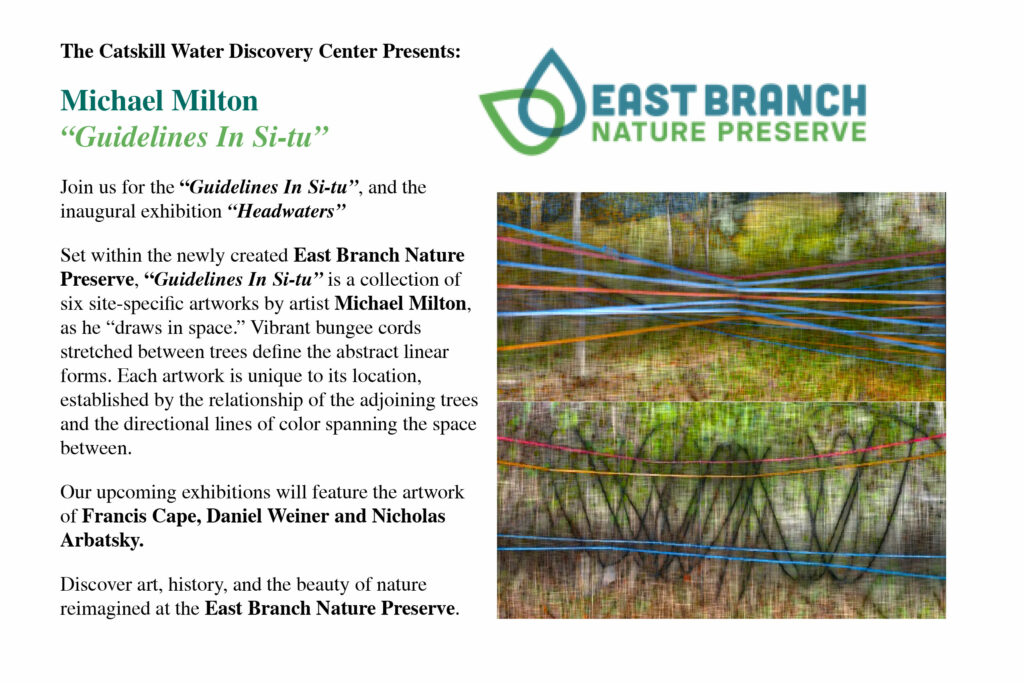
The East Branch Nature Preserve is also an outdoor exhibition space with visiting exhibits that integrate art and nature. Michael Milton’s “Guidelines In Si-tu” is a featured installation at the East Branch Nature Preserve and was recently extended at the end of 2025 with a few new pieces. All are welcome to visit this installation as the East Branch Nature Preserve is open year-round.
Another recently added exhibit was “Snowcatchers” (below) which was installed on December 20th, 2025. “Sawtooth/Snow” are provided by Arena Arts Initiative using cutoffs from the milling of material for the future Francis Cape Project.
Also, in 2025 we said goodbye to the exhibit “Headwaters”, which was taken down in 2025.
Here is a last glimpse of “Headwaters” in the snow in December:





Recent Comments